


The Single API Ecosystem: How Unified Technology Accelerates iGaming Operator Expansion
As iGaming operators expand into new markets, the challenge is no longer simply accessing
enough gaming content. The technical architecture supporting that content can become
increasingly complex as operators add providers, games, payment services, wallets, reporting
tools, and other third-party systems.
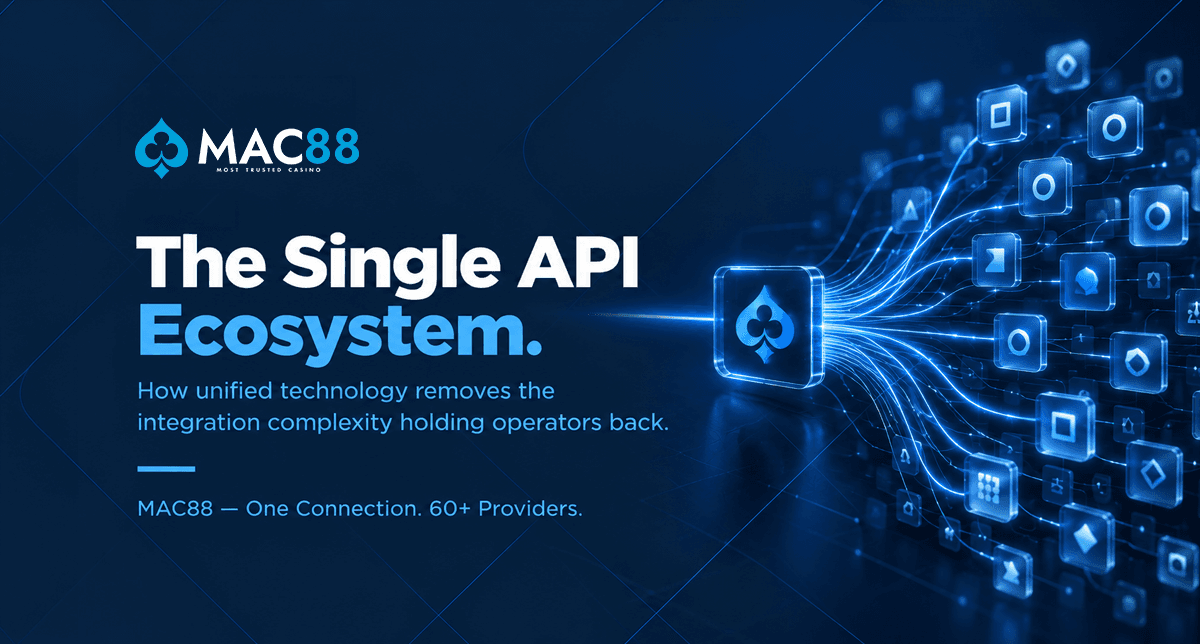
MAC88’s Single API approach addresses this complexity by creating a unified integration point
between operators and a broader gaming ecosystem. Through one connection, operators can
access more than 60 global providers and thousands of games, reducing the need to build and
maintain individual integrations across their technology stack.
The result is an infrastructure model designed around scalability: integrate once, access a wider
ecosystem, and manage the technology through a more centralized layer.
The Architecture Behind a Single Integration
A traditional multi-provider model can require an operator to establish separate technical
connections with each gaming provider it wants to add to its platform.
Every additional connection potentially introduces its own API specifications, authentication
processes, technical documentation, testing requirements, monitoring, and maintenance
workload.
A unified aggregation layer changes that structure.
MAC88’s Single API acts as an intermediary between the operator’s platform and the integrated
providers within its ecosystem. Rather than connecting independently to every provider, the
operator connects to MAC88 once, while MAC88 manages the technical connectivity with the
providers available through the aggregation platform.
This creates a more standardized architecture from the operator’s perspective and allows the
gaming portfolio to grow without necessarily increasing technical complexity at the same rate.
One Connection, More Than 60 Providers
The practical impact becomes clearer as the number of providers increases.
With more than 60 providers connected to its ecosystem, MAC88 enables operators to access a
broad range of gaming content through a single integration. The portfolio can include slots, Live
Casino, and other gaming verticals, allowing operators to build market-specific catalogues
without developing a new technical integration for every addition.
For example, an operator that wants to work with ten different providers does not necessarily
need to manage ten separate integration projects when those providers are available through
MAC88. The operator’s core integration is with MAC88, while the aggregation layer handles
connectivity with the providers.
This does not eliminate the technical requirements of the individual games or providers. Instead,
it centralizes a significant part of the connectivity layer, giving the operator a more consistent
technical environment through which to manage its content ecosystem.
Reducing Go-to-Market Complexity
Technical integration is closely connected to how quickly an operator can bring a new market or
product proposition online.
Under a fragmented model, every additional provider can add development, testing, and
deployment work. When multiple integrations are being developed simultaneously, technical
teams must coordinate different specifications and release processes.
A unified API can reduce this dependency by providing a common integration point.
This is also the principle behind MAC88’s Swift Launch proposition for Mexico, which is
designed to support online casino launches within 7–14 days, with zero upfront implementation
costs.
The timeframe depends on the scope and requirements of each project, but the underlying
objective is consistent: remove unnecessary technical friction so operators can dedicate more
resources to commercial activities such as localization, player acquisition, marketing, and
market development.
The Operational Cost of Technical Complexity
The impact of integration architecture does not end when a platform goes live.

Every technical connection requires ongoing attention. Changes to APIs, provider updates,
testing, incident management, and performance monitoring can create a continuous workload
for an operator’s technology team.
When this workload is distributed across numerous direct integrations, maintenance becomes
increasingly fragmented.
A centralized aggregation layer can simplify this operational model by giving the operator a
common connection point. MAC88 manages the connectivity between its platform and the
integrated providers, while the operator can work through a more consistent interface.
This can help reduce the number of individual technical relationships that internal teams need to
monitor and maintain.
For businesses operating across multiple markets, the effect can become particularly relevant
because technical resources must often support several regulatory, commercial, and content
requirements simultaneously.
Beyond Game Aggregation
The Single API concept also extends beyond simply making games available.
Modern iGaming infrastructure typically involves multiple interconnected components, including
wallets, payments, player accounts, bonuses, reporting, responsible gaming systems, and third-
party services.
An aggregation layer can therefore play a broader architectural role by providing a structured
point through which different services can interact with the operator’s technology environment.
MAC88’s infrastructure supports integrations involving gaming content as well as elements such
as wallets, payments, and operational data, allowing operators to approach their technology
stack as a connected ecosystem rather than a collection of isolated integrations.
The objective is not to remove every layer of technical complexity. It is to centralize and
standardize the parts of the infrastructure that can otherwise become repetitive as an operation
scales.
Security and Reliability at the Integration Layer
Centralization also makes the architecture behind an API particularly important.
A technology layer connecting operators with multiple external providers needs to incorporate
appropriate authentication, encryption, data protection, and access controls. Monitoring and
reliable communication between systems are also essential to maintaining operational
continuity.
For operators, the value of a unified API therefore depends not only on the number of providers
it connects but also on the reliability and security of the infrastructure supporting those
connections.
MAC88’s approach places this integration layer at the center of its technology proposition,
combining aggregation with technical support and operational visibility.
Scaling Without Multiplying Technical Work
The fundamental principle behind the Single API ecosystem is straightforward: growth in
content should not automatically mean proportional growth in integration complexity.
An operator can expand its catalogue by accessing providers already connected to the
aggregation ecosystem rather than repeatedly starting from zero with each new supplier.
This creates a technology foundation that can support expansion while keeping the operator’s
core integration architecture more manageable.
For B2B iGaming businesses, that distinction can have a direct operational impact. Faster
integration can shorten the path to market, while a more centralized infrastructure can reduce
the ongoing burden placed on development and technical operations teams.
MAC88’s Single API model is therefore positioned not simply as a way to aggregate games but
as an infrastructure strategy for operators looking to scale their businesses without allowing
technical complexity to become a constraint on growth.